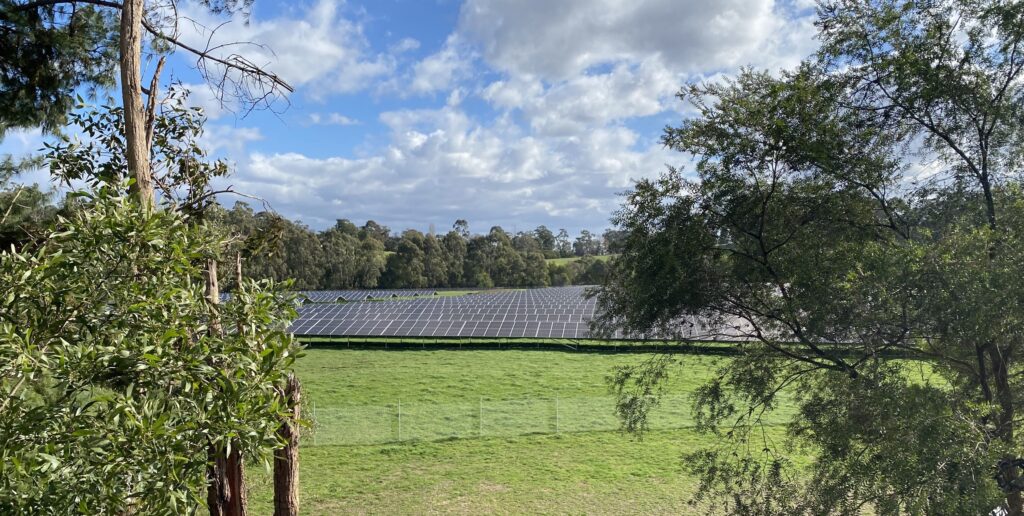
Sensitive Design
TSA is committed to listening and responding to the communities in which it operates. This means addressing concerns about land use, visual impact, long-term viability, and the equitable distribution of savings, always with openness and evidence-based solutions.
- Cultural Heritage: TSA acknowledges the Wurundjeri as the original inhabitants of the land and made the project as low impact as possible.
- A no dig policy and engineering innovation was enacted so land was not disturbed.
- A design sympathetic to the site using as little space as possible.
- Visual Impact: Design the site with consideration for aesthetics and local input.
- Hidden from view by trees which are still young and growing.
- Diseased and dead pine trees have been removed and will be replaced by local species to create wildlife corridors across the site.
- Land Use: Ensure no critical farmland or biodiversity is compromised, and explore dual-use opportunities where possible.
- The land has been underutilised and losing money for many years.
- The land under the solar panel will have sheep grazing to minimise the need to mowing or weeding.
- No farming land will be lost as the same amount of land can still be used for sheep grazing.
- Transparency: Provide accessible records of project savings and their allocation to community services.
- Longevity: Share plans for ongoing maintenance and future-proofing both the solar farm and the programs it supports.
- The solar farm has an expected commercial life in excess of 25 years with minimal maintenance costs.
- A battery may be added to the project to further improve the economic benefits to the local community and TSA’s other sites.
- Key Information
- 11,000 Canadian Solar 700/705 watt bifacial panels (7.7MW DC)
- 2 x SMA 2475 Medium Voltage Power Stations (4.95MW AC)
- Solar Mounting Systems East West mounting system (using 30% less space than tracking or traditional north facing systems)
- 8.3GWh expected annual output (80% of The Salvation Army Vic daytime needs saving up to $1.5M/annum)
- 100+ sheep (keeping the grass under control without mowing or herbicides)